
The city born around a hot spring
According to legend, King Vakhtang Gorgasali was hunting in the woods of the area and sent his falcon after a bird. Both fell into a hot spring and came out “cooked.” The king decided that a place with waters like these should be a city — hence the name: “Tbilisi” means “warm place” in Georgian.
Around those springs grew the Abanotubani district, and to this day its round domes with their purplish steam are the city’s most recognizable symbol. But Tbilisi is far more than a symbol — it’s layer upon layer of cultures, invasions, splendor and reconstruction.
What to see in Tbilisi
1. The Abanotubani district — the sulfur baths
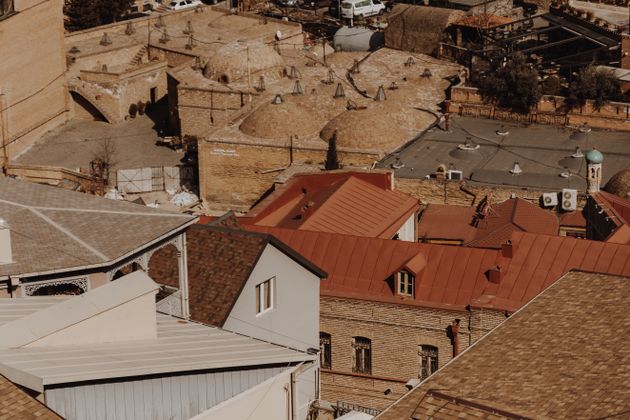
What it is: a historic district of sulfur bathhouses, the very heart of Tbilisi. White-and-reddish domes, cobbled lanes, restaurants spilling out into the street.
Don’t miss: going into a private bathhouse and using the “kisa” — a traditional scrub on a stone slab. A private room with a hot sulfur pool usually costs 80–170 lari per hour.
Tip: it’s best to go at dusk, after a day around the city. In winter it’s a perfect experience; in summer you come out genuinely cooled.
2. Narikala fortress and the “Mother of Georgia”
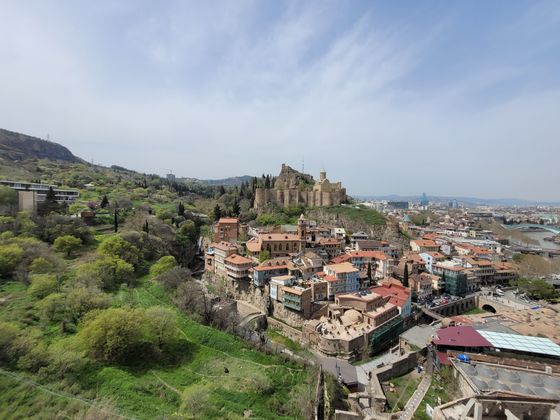
What it is: an ancient fortress rising over the old town. From the walls — a panoramic view of the whole city, the river and the bridges. Beside it stands the “Kartlis Deda” statue — the Mother of Georgia — with a sword in one hand and a cup of wine in the other.
Getting there: by cable car from Rike Park (about 2.5 lari per ride, with the Metromoney card). Entry to the walls is free.
Local tip: ride up an hour before sunset, walk along the walls and come down through the National Botanical Garden straight to Abanotubani — a perfect chained day.
3. The Sololaki district
What it is: a 19th-century bourgeois district, with art-nouveau houses, traditional wooden balconies and decorated stairwells built in the Russian era. Every corner reveals a different house with ironwork, marble floors and forgotten ornaments.
What to do: stroll along Galaktion Tabidze and Ivane Machabeli streets, peek into the inner courtyards and find a small, dimly lit café.
4. The National Botanical Garden
What it is: an enormous green valley that opens behind Narikala fortress — trails, waterfalls, little bridges and trees from all over the world. Entry about 4–5 lari.
Tip: the classic combination — walk down through the garden after visiting Narikala, and arrive straight at Abanotubani.
What to eat

Adjaruli khachapuri: a “boat” of dough filled with cheese, egg and butter stirred together. The national dish — you have to try it.
Khinkali: large dough dumplings filled with meat and broth. Eaten with the hands — you bite, sip the broth and carry on.
Pkhali: vegetable spreads (beetroot, spinach, eggplant) with walnuts and spices — an excellent starter.
Local tip: the restaurant at the Dezerter Bazaar (Dezertirebis) is one of the most reliable local spots to eat. Don’t look for restaurants on the main streets — the good ones hide in inner courtyards.
Getting around the city
Metromoney card: essential. It costs 2 lari at any metro station and is topped up at machines. One ride costs 1 lari and allows free transfers within the next 90 minutes — including the cable car to Narikala.
Taxis: Bolt only. Street taxis — inflated prices. Bolt shows the price upfront and arrives fast.
Accommodation: if you’re after a hotel in the center — compare prices on Booking.com. For guided city tours — GetYourGuide.
Classic one-day route:
- Morning — local market and churchkhela
- Midday — Abanotubani, the Bridge of Peace, the Kura River
- Afternoon — cable car to Narikala, sunset from the walls
- Evening — the Botanical Garden, Abanotubani, the sulfur baths
Dress and customs
In churches: women — covered shoulders and, ideally, a skirt. Men — no hat. Most places lend scarves at the entrance.
Hospitality: Georgians are famous for their welcome. If you’re invited to a meal, you’ll find a “supra” — a loaded table. Drinking a glass of honor is a must.